


by Charlie Loeb
Kudos to the City of Eugene for moving swiftly to make Patterson Street safer for cyclists and pedestrians!
A previous article highlighted the “double threat” problem on Patterson which makes it particularly dangerous for pedestrians and cyclists to cross the two-lane, one-way street; a fact tragically illustrated when a car traveling at high speed struck and killed graduate student Erick Njue this past January. Unfortunately, Patterson is not unique. In fact a very similar collision occurred the prior September when UO student Elizabeth Cardenas Figueroa was struck and killed on Hilyard Street at 8th Avenue.
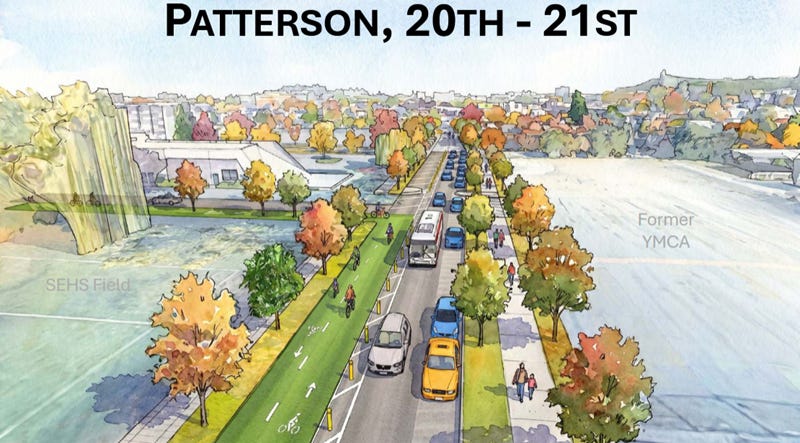
But Patterson is unique in the City’s quick response. The City has already put out to bid construction of a pilot project to redesign the street from 18th to 24th, principally by narrowing the road to a single south-bound travel lane with the remainder of the street space used for bike lanes, parking, and bus stops. Mayor Kaarin Knudsen described the project on her Instagram feed, and the transportation planning staff have a brief description on the City’s website. The City will complete the redesign with temporary materials and study the impacts before investing in a permanent change to the road. The hope is to complete the changes before students return to the University of Oregon for fall semester - just 8 months from crisis to solution. That seems like a long time, but for a transportation project it is light speed.

A Confluence of Factors
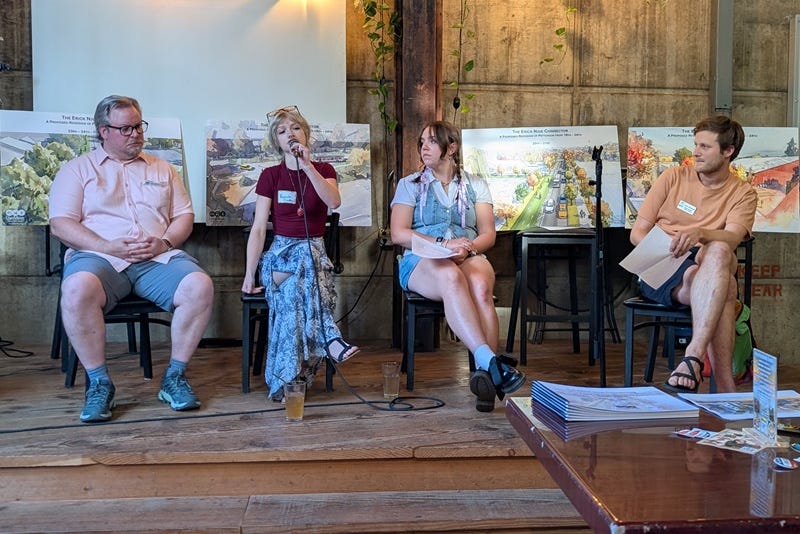
What accounted for the quick response? Cyclists and pedestrians regularly ask the City for interventions to make the city’s streets safer, but rarely see such fast action on anything more than a maintenance request. Other recent fatal crashes on Highway 99 and River Road have not led to similar action, although there are plans underway. At both a recent meeting of Eugene’s Active Transportation Committee (ATC) and at a BEST Happy Hour, City staff described the confluence of factors that made the Patterson pilot project possible.
First, Patterson Street has a relatively low traffic volume, similar to Pearl Street which also narrows from two lanes to a single lane at 19th. The current two-lane street design has more capacity than it needs.
Second, a low-cost intervention is possible using paint, temporary bollards, and other inexpensive materials. Students from the University of Oregon’s LiveMove program developed an initial design demonstrating to the community how such a project could be accomplished, and that design sparked a lot of discussion not just in the community, but among City staff and decision-makers.
Third, there were small buckets of money available that could be captured from other projects and from partners such as Lane Council of Governments. University of Oregon’s Transportation Services offered assistance with bollard installation.
Fourth, the single-lane redesign actually works better for some key equipment. Lane Transit District buses could not previously navigate the S-turn south of 22nd within their lane, thus forcing the buses to go to 24th to make a left, then a right on Hilyard. Now the buses will stay on Patterson as it jogs over to become Hilyard south-bound. Likewise large fire trucks will be able to navigate the S-turn without crowding out cars in an adjacent lane.
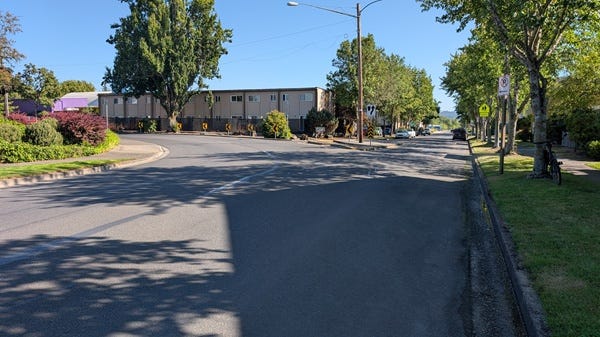
But finally, and most importantly, there was a tremendous level of community insistence that the City take action. Within 3 weeks of the tragic death, eight community organizations came together to host a Transportation Safety Forum which attracted more than 200 motivated participants. The LiveMove students put together their design. The ATC requested staff to undertake near-term interventions. The UO Graduate Teaching Fellows Federation organized a day of public comment at a Eugene City Council meeting. SHIFT Community Cycles organized a memorial ride for all the cyclists recently killed in Eugene which started by the crash site at Spencer View Apartments. Friends of Erick and student groups placed highly visible signs along Patterson providing a daily reminder that there is a safety issue which needs to be fixed. BEST engaged with city administrators and kept information flowing among the various groups. All of this activity - and likely more that I am unaware of - created a sense of urgency and provided space for City staff to prioritize resources to address the problem.
Can We Do It Again?
That the City was responsive to this outpouring of community sentiment is wonderful and demonstrates that change can happen quickly.
That it took a fatality, a tremendous amount of community organization and work, and an unusual confluence of other factors before this known safety hazard could be addressed is unfortunate. Why is it so hard when everyone involved wants our streets to be safe?
The answer is, of course, complicated, and involves money and priorities and competing interests. At the BEST Happy Hour, Rob Zako (executive director of BEST) proposed that the next City transportation bond reserve discretionary funds which staff could use for this kind of urgent need. Such a fund could provide a mechanism for quick fixes, but not proactively address larger safety issues. For the latter it is important for activists to be involved in the pending Transportation System Plan update which the City of Eugene will be starting next year and which will define priorities for the next two decades.
As a final note, potentially the most important outcomes are the strong relationships which developed in the course of working on the community response. Notably, the City of Eugene transportation planners are exploring ongoing cooperation with UO’s student-led LiveMove program, and BEST is seeking to formalize a collaboration among the various involved organizations for ongoing work on transportation safety. The power for systemic change is in these relationships. Don’t hesitate to join in.
Correction, August 20, 2026: As originally published the article twice inaccurately used the word “accident” to describe the collisions that killed cyclists in Eugene. This word is inaccurate because it implies that the fatal incidents were no one’s fault or were inevitable or unavoidable. This is rarely the case since they are almost always preventable and avoidable. The word has been changed to either “collision” or “crash” in the article.
Fabulous. Thank you and so glad for the changes. Feels like what we also need is enforcement/penalties for speeding and reckless driving. When was the last time you saw someone pulled over for running a red light or for speeding?
This a GREAT write-up, Charlie! Thank you.