
Double Threats
Students mobilize to end them

By Sue Wolling
As many are aware, there has been an epidemic of bicyclist deaths on Eugene’s streets in recent months: at 8th & Hilyard, on Patterson Street, on Highway 99 and on River Road. The latter two – Highway 99 and River Road – are high-volume streets that are known to be hazardous, and are being studied for changes to improve safety for all modes of travel.
The other two also have something in common – namely, a “double threat” that can occur when crossing a two-lane, one-way street, where driving speeds are often high. Both the fatality at 8th & Hilyard and that on Patterson occurred when a bicyclist was waiting to cross a two-lane street, a car in the nearest lane stopped to allow the bicyclist to cross, but when s/he did, another car in the second lane crashed into and killed the unsuspecting bicyclist.
Experienced bicyclists are generally aware of this double threat danger, usually because they have experienced a close call themselves. They know to wave the “polite” driver on, waiting until they have a clear view of both travel lanes to judge when it is safe to cross. Less wary or less experienced cyclists may not recognize the risk, and anyone might let their guard down if busy or distracted.
The most significant response to these recent tragedies has come from the people close to Erick Njue, who was killed on Patterson Street. They have placed many visible signs along the street to call attention to the site of the fatal crash and plead with motorists to drive safely. In addition, students of the University of Oregon group LiveMove have designed a simple, low-cost modification of this section of Patterson to eliminate the double threat, slow traffic, and improve safety for everyone.
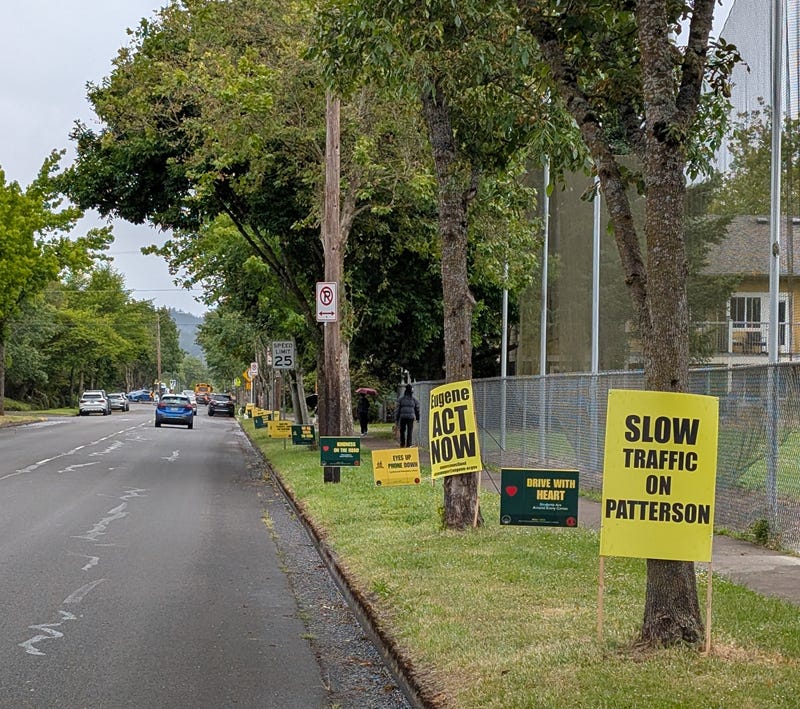
Making all of Eugene’s streets safe for walking and bicycling is a tall order, but these young people are showing us a way to make quick, meaningful change on streets like Patterson where excessive width and too many travel lanes promote dangerous driving. The proposal for Patterson might not be the ultimate best design for the street, and other comparable streets (Hilyard, Oak, Lawrence, Washington/Jefferson, Franklin, Cal Young and others) might need a different treatment, but the LiveMove work is a model of simple, inexpensive, possibly temporary interventions that can reduce the risk that more people will die simply because they crossed a street on a bicycle.
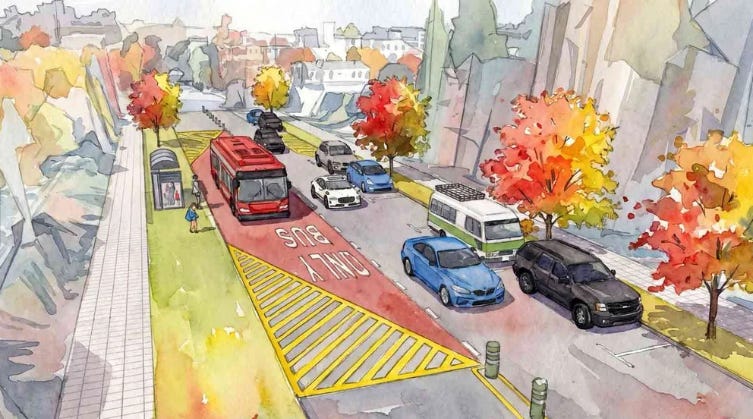
Thanks for writing this. I should also note that the students' work was done in under 3 weeks, without pay or academic credit, and on top of a full academic load and other paid employment responsibilities. That is - they really care about their community even if most of them will graduate and move elsewhere. They simply became tired of waiting for any official public response after five months since fellow classmate Eric Njue was killed. They created something reacting to a preventable tragedy to help the city proactively prevent another one. Oh - and their visual representations are beautiful and their report has more detail behind the nice images. Thanks for highlighting the issues so directly, clearly, and succinctly.